France Toys Market Report by Toys Segmentation, Sales Channel, Cities and Company Analysis 2026-2034
Buy NowFrance Toy Market Size and Forecast
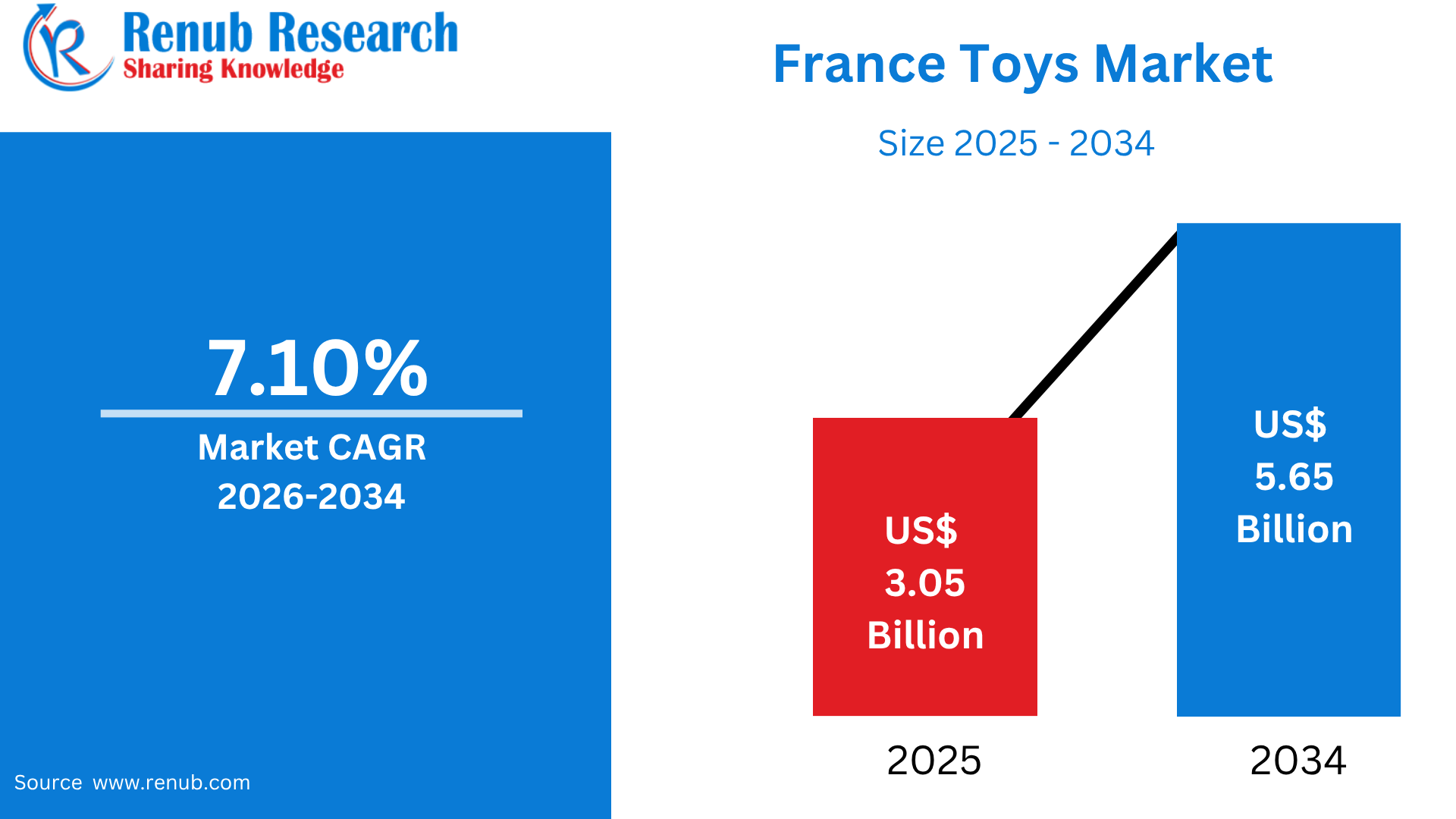
The France Toy Market is projected to grow from US$ 3.05 billion in 2025 to US$ 5.65 billion by 2034, registering a CAGR of 7.1% during 2026–2034. Market expansion is being supported by the growing kidult segment, comprising teenagers and adults who purchase toys for entertainment, collecting, nostalgia, and hobbies. Rising demand for licensed characters, collectible products, and premium toys is also contributing to market growth. In addition, the rapid expansion of online retail and e-commerce platforms is improving product accessibility, offering consumers greater convenience and a wider selection of toys.
What are Toys and their Uses & Popularity in France
Toys are products designed primarily for children’s play, entertainment, learning, creativity, and social development, while increasingly attracting teenagers and adults through collectibles, construction sets, licensed merchandise, puzzles, and hobby products. In France, toys are widely used as educational and recreational tools that help develop children’s motor skills, problem-solving abilities, imagination, communication, and cognitive development. The market includes dolls, action figures, building sets, board games, puzzles, outdoor toys, electronic toys, arts and crafts products, and licensed character merchandise.
Toys remain an important part of French household spending and gifting, particularly during birthdays and the Christmas season. The French toy and games market recorded strong growth in 2025, with Circana reporting a 7.1% increase in value to €4.7 billion, its strongest annual performance in more than two decades. Demand is also expanding beyond children as the kidult segment becomes increasingly important. Circana reported that purchases by teenagers and adults increased 22% during 2025, highlighting the growing popularity of collectibles, licensed products, and hobby-oriented toys in France.
Population Under 10 Years in France (2022–2025)
- 2022: Approximately 7.55 million children under 10 years in France, comprising 3.56 million children aged 0–4 and 3.99 million aged 5–9.
- 2023: Approximately 7.15 million children under 10 years based on INSEE’s 2023 population census, including 3.36 million aged 0–4 and 3.79 million aged 5–9.
- 2024: INSEE’s population estimates indicate continued demographic decline among young children. The age structure shows that children aged 0–9 represented a smaller share of the population than in previous years, reflecting declining births.
- 2025: The under-10 population continued to face downward demographic pressure as births declined. INSEE reported 643,905 births in France in 2025, 2.3% fewer than in 2024 and around 24% fewer than in 2010, indicating a shrinking future base of young toy consumers.
Growth Drivers of the France Toy Market
Rising Kidult and Collectible Toy Demand
The growing participation of teenagers and adults in the toy market is creating an important source of demand in France. The kidult segment, generally covering consumers aged above 12 or 13, increasingly purchases construction sets, collectible figures, board games, licensed merchandise, and nostalgia-driven products for personal enjoyment rather than traditional child-focused play. Circana reported that purchases by adolescents and adults in France increased 22% during 2025, making this demographic an important contributor to market expansion. The wider global trend also supports the French market: across 12 major markets tracked by Circana, toy sales increased 7% in value in 2025, with growth supported by pop culture, licensed products, collectibles, and stronger engagement from teens and adults. Manufacturers and retailers are therefore expanding adult-oriented collections, premium building sets, character merchandise, and limited-edition products. The combination of fandom, nostalgia, social-media influence, and collecting behavior is broadening the consumer base beyond children and helping offset demographic pressure from declining birth rates.
Strong Seasonal and Gifting Demand
Seasonal purchasing, particularly around Christmas, remains a major growth engine for the French toy industry. Toys are strongly associated with gifting occasions such as Christmas, birthdays, family celebrations, and other special events, resulting in substantial increases in sales during the final months of the year. Industry data indicate that 45% of annual toy sales in France were generated during November and December 2025, demonstrating the importance of the Christmas shopping period. Another 2025 industry report indicated that the fourth quarter accounted for 52% of annual sales during the year, reflecting the concentration of demand around the holiday season. Retailers capitalize on this period through promotional campaigns, new product launches, licensed collections, gift-oriented packaging, and expanded inventories. Parents and relatives also increasingly purchase toys as entertainment and gifting products, while collectible and premium products provide additional opportunities to increase spending per purchase. Strong holiday demand therefore provides manufacturers and retailers with a significant annual sales opportunity and supports overall market revenues.
Expansion of Retail Channels and Product Innovation
The development of specialist stores, supermarkets, online platforms, and omnichannel retail is improving access to toys across France. Although physical stores remain highly important, consumers increasingly combine online research, digital purchasing, promotions, and in-store shopping when buying toys. In 2024, specialist toy retailers represented approximately 42% of the French toy market, while the specialist channel recorded 6.3% growth, demonstrating the continuing importance of dedicated retail environments. At the same time, manufacturers are continuously introducing innovative products based on popular entertainment franchises, construction, educational play, collectibles, and emerging cultural trends. In 2025, Games & Puzzles grew 30% globally across Circana’s 12 tracked markets, while Building Sets increased 18%, illustrating the strength of product categories centered on creativity, engagement, and collecting. In France, the combination of product innovation and multiple sales channels allows companies to reach children, parents, teenagers, adult collectors, and gift buyers more effectively.
Challenges of the French Toy Market
Declining Birth Rate and Changing Demographics
Declining birth rates represent a structural challenge for the French toy market because the traditional customer base is closely linked to the number of children in the population. According to INSEE, approximately 643,905 babies were born in France in 2025, representing a 2.3% decline from 2024 and approximately 24% fewer births than in 2010. The fertility rate also declined to around 1.56 children per woman in 2025, its lowest level since the end of the First World War, according to INSEE. A smaller population of young children can reduce the long-term addressable market for traditional toys such as dolls, infant products, preschool toys, and basic playsets. Manufacturers and retailers are therefore increasingly required to diversify their consumer base by targeting older children, teenagers, adults, collectors, and families. The rise of kidult products can partially compensate for demographic pressure, but the declining number of births remains a long-term structural consideration for companies operating in France.
Online Marketplace Safety, Competition and Compliance Risks
The rapid development of online marketplaces creates opportunities for toy companies but also introduces stronger competition and product-safety concerns. Consumers can access a broad range of imported toys through third-party sellers, often with significant price differences compared with established retailers. This creates pressure on traditional manufacturers and distributors regarding pricing, brand differentiation, and compliance. The French Federation of Toy and Childcare Industries reported in November 2025 that 96% of toys purchased on online marketplaces from non-European third-party sellers were non-compliant, while more than 86% were considered dangerous for children according to its testing initiative. Such findings highlight concerns regarding product safety, regulatory compliance, traceability, and consumer protection. At the same time, established manufacturers must comply with stringent European toy-safety requirements while competing with lower-cost products. Ensuring product quality, authentic certification, responsible sourcing, and supply-chain transparency can increase operating costs. Consequently, companies need effective marketplace monitoring, quality assurance, and brand-protection strategies to maintain consumer trust.
Toy Launches in France
- LEGO DUPLO Peppa Pig Sets – 2024: LEGO and Hasbro introduced four new LEGO DUPLO Peppa Pig sets in 2024, combining construction play with characters and settings from the Peppa Pig series. The products were designed for toddlers and promoted imaginative and role-play activities.
- PLAYMOBIL Monster High Collection – 2025: PLAYMOBIL partnered with Mattel to launch a Monster High collection in the EMEA region in autumn 2025. The range features characters including Draculaura and Clawdeen Wolf, bringing the popular franchise into PLAYMOBIL’s storytelling format.
- PLAYMOBIL Port des Pirates – 2025: PLAYMOBIL introduced its new Pirates-themed play range, including the Port des Pirates set, featuring pirate adventures, ships, sea creatures, and interactive storytelling elements.
- PLAYMOBIL Princess Castle – 2025: A new Princess Castle range was introduced as part of PLAYMOBIL’s 2025 novelty portfolio, targeting children interested in fantasy, role-play, and fairy-tale storytelling.
- PLAYMOBIL Farm Range with Recycled/Bio-Based Materials – 2025: PLAYMOBIL expanded its sustainable product portfolio with a new Farm theme made using recycled and bio-based materials, reflecting increasing attention to sustainability in toy design and manufacturing.
- LEGO Nike Air Force 1 Set – 2026: LEGO introduced the Nike Air Force 1 x LEGO set for older children and collectors. The 1,093-piece model combines sneaker culture with LEGO construction and is listed as a new product on the French LEGO website.
- LEGO Ayrton Senna Helmet – 2026: LEGO launched the Ayrton Senna Helmet construction set for ages 14+, targeting motorsport enthusiasts and adult collectors. The product contains 931 pieces and expands LEGO’s portfolio of display-oriented licensed models.
- LEGO SpongeBob SquarePants Collection – 2026: LEGO introduced new SpongeBob SquarePants products in France, including a Bikini Bottom construction set and SpongeBob collectible figure, combining licensed entertainment with construction and collecting.
- LEGO Batman Returns Batmobile – 2026: LEGO added the Batman Returns Batmobile to its French new-product portfolio, offering a detailed construction model aimed at adult collectors and superhero fans.
- LEGO Star Trek: U.S.S. Enterprise NCC-1701 Bridge – 2026: LEGO introduced a Star Trek-themed construction model featuring the bridge of the U.S.S. Enterprise NCC-1701. The product targets the growing adult collector and licensed-merchandise segment in France.
Licensing, Pop Culture, and the Growing Collector Base
France action figures market is supported by strong demand for licensed characters, entertainment franchises, and collectible merchandise. Action figures based on films, streaming series, comics, anime, and video games appeal to both children and adult collectors, creating demand across multiple age groups. The expanding kidult segment is particularly important, with purchases by French teenagers and adults increasing 22% in 2025, according to Circana. This trend is encouraging manufacturers to develop premium figurines, limited editions, highly detailed models, and nostalgia-oriented collections. Retailers and online marketplaces are increasing visibility for collectible products, while specialist hobby stores provide dedicated channels for enthusiasts. Comic conventions, gaming events, and fan communities further strengthen franchise engagement. The combination of entertainment licensing, collecting culture, social-media exposure, and product innovation is therefore helping action figures maintain a dynamic position within France’s toy industry.
Educational Play and Adult Building Enthusiasm
Construction sets and models remain an important category in France because they combine entertainment with hands-on learning, creativity, and problem-solving. Products range from basic construction blocks and STEM-focused kits for children to sophisticated mechanical, architectural, automotive, and licensed models for teenagers and adults. The category is also benefiting from the expanding kidult market, as older consumers increasingly purchase building sets for hobbies, collecting, nostalgia, and display. Globally, Circana reported that Building Sets sales increased in 2025 across 12 major toy markets, highlighting strong consumer interest in construction-based products. In France, parents increasingly consider hands-on toys valuable for developing spatial awareness, concentration, fine motor skills, and creativity, while families often select construction sets as educational gifts. Retailers also use workshops, demonstrations, and themed displays to increase engagement. Innovation in modular designs, licensed franchises, sustainable materials, and digitally supported building experiences is expanding the category’s appeal. These trends are helping construction sets serve both traditional children’s play and the rapidly growing adult hobby and collector market.
Wide Assortment, Competitive Pricing, and Omnichannel Retail
Toy hypermarkets and large-format retailers continue to influence toy purchasing in France by providing consumers with broad assortments, competitive prices, and convenient access to multiple product categories. These stores typically offer traditional toys alongside action figures, construction sets, board games, outdoor products, licensed merchandise, and technology-oriented toys, enabling families to compare products in one location. Large retailers strengthen their position through seasonal promotions, supplier negotiations, exclusive bundles, loyalty programs, and high-visibility Christmas campaigns. Omnichannel capabilities are becoming increasingly important, with retailers integrating online catalogues, home delivery, reservation services, and click-and-collect options. This approach allows consumers to research products digitally while retaining access to physical stores for product discovery and demonstrations. As French toy purchasing remains highly seasonal, particularly during November and December, large-format retailers benefit from strong holiday traffic and promotional activity, supporting their continuing role in the national toy distribution landscape.
Paris Economic Concentration and Premium Consumer Demand
Paris Region, or Île-de-France, represents the largest economic hub in France and is a particularly important market for toys, games, collectibles, and other leisure products. The region contributes approximately 30% of France’s national wealth and around 5% of the European Union’s GDP, reflecting its concentration of businesses, high-value services, tourism, and consumer activity. Its large and diverse population creates a substantial customer base for children’s toys as well as premium collectibles and hobby products. Paris also benefits from dense retail networks, department stores, specialist toy shops, shopping centres, and extensive e-commerce infrastructure. Tourism provides an additional source of demand, particularly through attractions such as Disneyland Paris, which generates strong exposure to character merchandise, licensed toys, and souvenirs. Higher-income consumer groups also support demand for premium construction sets, collectibles, branded toys, and limited-edition products. The combination of economic strength, population density, tourism, and sophisticated retail infrastructure makes Île-de-France a significant regional market for France’s toy industry.
Auvergne-Rhône-Alpes Large Population Base and Stable Household Spending
Auvergne-Rhône-Alpes represents one of France’s most important regional consumer markets, supported by a substantial population and diversified economy. The region has more than 8 million residents, making it the second-most populous region in France and providing a large potential customer base for toys, games, hobbies, and recreational products. Major urban centres including Lyon, Grenoble, and Clermont-Ferrand support extensive retail activity and provide access to specialist stores, shopping centres, supermarkets, and online distribution channels. The region’s economic structure spans manufacturing, technology, tourism, commerce, healthcare, and professional services, contributing to relatively stable employment and household consumption. A significant family population further supports demand for educational toys, construction sets, outdoor products, board games, and traditional children’s toys. At the same time, growing interest in hobby products and collectibles provides opportunities beyond the children’s segment. The combination of population scale, economic diversity, urbanisation, and family-oriented consumption patterns gives Auvergne-Rhône-Alpes a broad and relatively diversified market base for toy manufacturers and retailers.
Nouvelle-Aquitaine Diverse Demographics and Expanding Retail Opportunities
Nouvelle-Aquitaine is a large and economically diverse French region that provides opportunities for toy and recreational product companies across both metropolitan and smaller communities. The region contributes approximately 7% of France’s national GDP, making it one of the country’s major regional economies. Bordeaux, Limoges, and Poitiers serve as important population and commercial centres, while numerous smaller towns support local retail networks. Its large geographic area creates a diverse distribution landscape encompassing shopping centres, supermarkets, independent toy stores, specialist retailers, and e-commerce platforms. Families with children contribute consistent demand for traditional toys, educational products, games, outdoor play equipment, and seasonal gifts. The region’s tourism sector also creates additional opportunities for licensed merchandise, souvenirs, and recreational products. Meanwhile, population movements toward major urban centres and attractive residential areas can support changing patterns of household consumption. Retailers can therefore target different consumer groups through differentiated product ranges, from affordable mass-market toys to premium construction sets and collectibles. These demographic, economic, and tourism characteristics position Nouvelle-Aquitaine as an important regional opportunity within France’s toy market.
Hauts-de-France Dense Population, Retail Accessibility, and Cross-Border Demand
Hauts-de-France is an important regional market for toys because of its large population, established retail infrastructure, and strategic location near Belgium and other northern European markets. The region has a dense network of shopping centres, supermarkets, specialist toy retailers, and independent stores, providing multiple purchasing channels for families and collectors. Its proximity to Belgium also creates opportunities for cross-border shopping and consumer flows, particularly around major urban and commercial areas. Lille serves as a major retail and transportation hub, supporting access to a broad surrounding consumer population. Demand is strengthened by family-oriented activities, sports clubs, cultural organizations, community events, and seasonal celebrations, which create opportunities for children’s toys, educational products, outdoor play items, games, and collectibles. The region’s retail environment also benefits from strong promotional activity around Christmas and other gifting periods. Meanwhile, the increasing importance of online shopping enables retailers to extend their reach beyond physical stores. The combination of population density, accessible retail networks, cross-border activity, and diverse family-oriented consumption patterns supports continued development of the Hauts-de-France toy market.
France Toys Market Segments
Toys Segmentation
- Action Figures
- Board Games
- Card Games
- Construction Sets & Models
- Dolls & Stuffed Toys
- Plastic & Other Toys
- Puzzles
- Toys for Toddlers & Kids
Sales Channel
- Hypermarkets
- Supermarkets
- Toy Specialists
- Multi-Specialists
- Others
Cities
- Paris
- Lyon
- Marseille
- Toulouse
- Bordeaux
- Lille
- Nantes
- Strasbourg
- Nice
- Montpellier
- Rest of Cities
All companies have been covered with 5 Viewpoints
- Overviews
- Key Person
- Recent Developments
- SWOT Analysis
- Revenue Analysis
Company Analysis:
- Mattel Inc.
- Hasbro, Inc
- LEGO
- Ravensburger
- Spin Master Corp.
- VTech
- Clementoni
- Thames & Kosmos
- Simba Dickie Group (Corp)
- HABA Sales GmbH and Co. KG
Report Details:
| Report Features | Details |
| Base Year |
2025 |
| Historical Period |
2022 - 2025 |
| Forecast Period |
2026 - 2034 |
| Market |
US$ Million |
| Segment Covered |
oys Segmentation, Sales Channel and Cities |
| Cities Covered |
|
| Companies Covered |
|
| Customization Scope |
20% Free Customization |
| Post-Sale Analyst Support |
1 Year (52 Weeks) |
| Delivery Format |
PDF and Excel through Email (We can also provide the editable version of the report in PPT/Word format on request) |
Customization Services available
- Analysis of Market Size and Its Segments
- More Company Profiles (Upto 10 without any additional cost):
- Additional Countries (Other than mentioned Countries):
- Region/Country Specific Reports:
- Market Entry Strategy:
- Region-Specific Market Dynamics:
- Regional Market Share Analysis:
- Trade Analysis:
- Production Insights:
- Others Customized Requests:
For more information contact our analysts.
Need More Assistance?
- Talk to our analysts to get more precious information on the current market trends.
- Include more countries and segments and customize the report based on the final requirement.
- Get a competitive advantage in your industry by knowing the report findings and making a positive impact on your revenues and operations.
- Our analysts are always ready to provide more help and pertinent information if you need any additional assistance.