Global Flour Market Report by Raw Material, Application, Sales Channel, Countries and Company Analysis 2026–2034
Buy NowGlobal Flour Market Analysis: Valuation, Grain Segments, and Long-Term Outlook
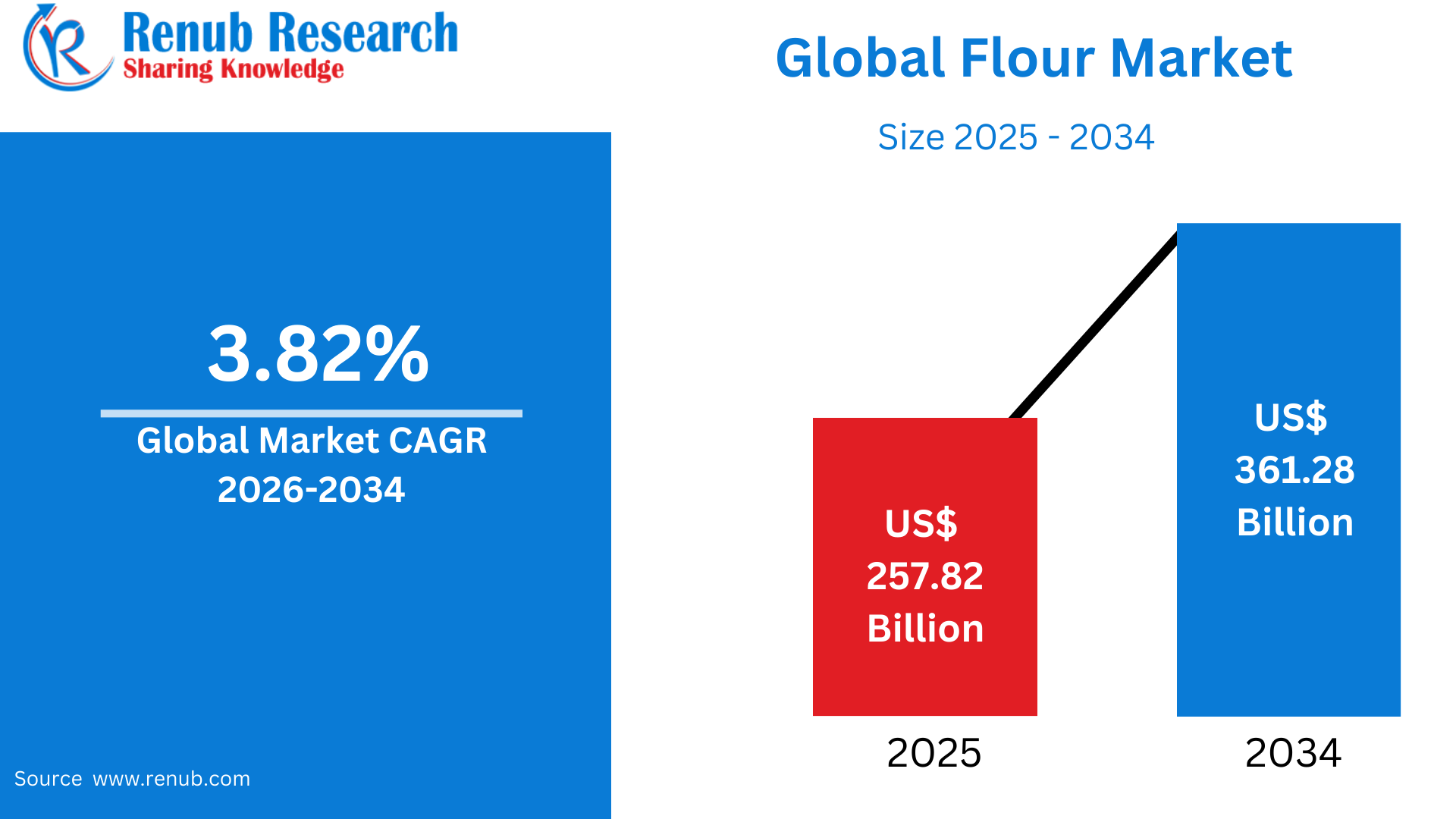
Flour Market is projected to grow from US$ 257.82 billion in 2025 to US$ 361.28 billion by 2034, registering a CAGR of 3.82% during 2026–2034. Market growth is driven by increasing demand for bakery products, packaged foods, and convenience meals, supported by population growth, urbanization, and changing dietary preferences. Rising consumer interest in gluten-free, whole grain, and fortified flour products, along with technological advancements in milling and the expansion of retail and foodservice industries, is further fueling market expansion.
Flour and its uses & popularity worldwide
Flour is a finely milled powder produced by grinding cereal grains, legumes, roots, or nuts into a uniform consistency. Wheat flour is the most widely consumed variety, while other commonly used types include rice flour, corn flour, oat flour, rye flour, barley flour, chickpea flour, almond flour, and coconut flour. Flour serves as a fundamental ingredient in food processing because it provides structure, texture, and consistency in numerous products. It is extensively used in the production of bread, cakes, biscuits, pastries, pizza, noodles, pasta, tortillas, breakfast cereals, sauces, batters, and snack foods. Beyond the food industry, specialty flours are utilized in infant nutrition, gluten-free products, sports nutrition, and fortified foods enriched with vitamins, minerals, and dietary fiber.
Worldwide, flour remains one of the most essential agricultural commodities due to its central role in daily diets and food security. Growing populations, rapid urbanization, and increasing consumption of bakery and convenience foods have significantly boosted global flour demand. Wheat flour continues to dominate the market, while gluten-free and specialty flours are gaining popularity among health-conscious consumers and individuals with dietary restrictions. Rising demand for whole-grain, organic, fortified, and protein-rich flour products is encouraging manufacturers to diversify their offerings. The expansion of commercial bakeries, quick-service restaurants, packaged food manufacturing, and modern retail channels further supports market growth. Continuous advancements in milling technology, improved grain processing, and increasing consumer awareness of nutrition are expected to sustain the worldwide popularity and long-term growth of the flour market.
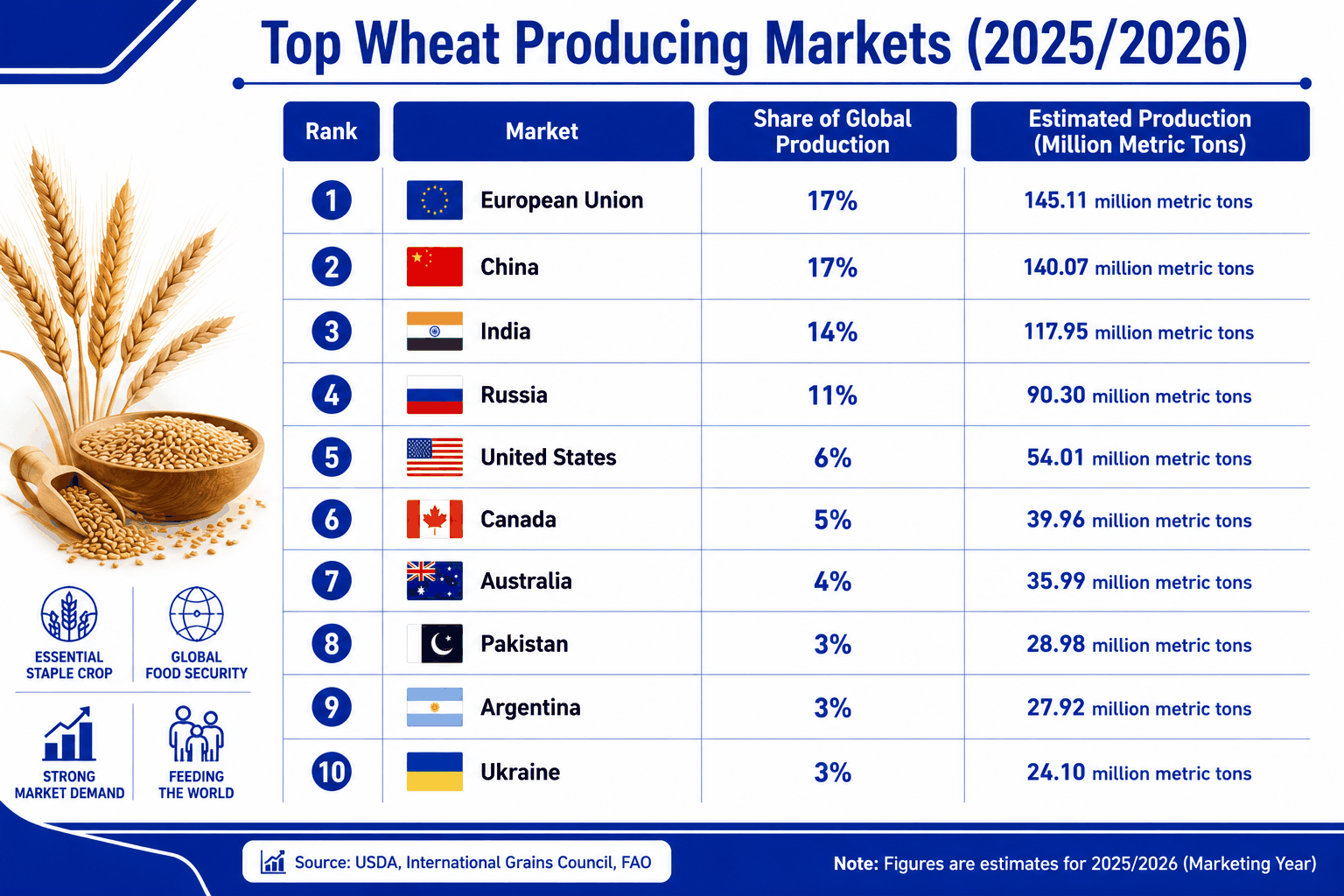
Top Wheat Producing Markets (2025/2026)
- European Union – 17% of global production, with an estimated 145.11 million metric tons.
- China – 17% of global production, producing approximately 140.07 million metric tons.
- India – 14% of global production, with an output of around 117.95 million metric tons.
- Russia – 11% of global production, producing approximately 90.30 million metric tons.
- United States – 6% of global production, with an estimated 54.01 million metric tons.
- Canada – 5% of global production, producing approximately 39.96 million metric tons.
- Australia – 4% of global production, with an output of around 35.99 million metric tons.
- Pakistan – 3% of global production, producing approximately 28.98 million metric tons.
- Argentina – 3% of global production, with an estimated 27.92 million metric tons.
- Ukraine – 3% of global production, producing approximately 24.10 million metric tons.
Growth Driver of the Flour Market
Rising Demand for Bakery and Convenience Food Products
The increasing global consumption of bakery products and convenience foods is one of the primary growth drivers of the flour market. Industry estimates indicate that more than 65% of wheat flour produced worldwide is utilized in bakery applications, including bread, cakes, biscuits, pastries, pizza, and other baked goods. Rapid urbanization, busy lifestyles, and rising disposable incomes have significantly increased demand for packaged foods, frozen bakery products, ready-to-cook mixes, and quick-service restaurant offerings. Flour serves as the essential ingredient that provides structure, texture, and consistency in these products. Expanding retail chains, supermarkets, and online grocery platforms have further improved product accessibility, encouraging higher flour consumption across both developed and emerging economies. Commercial bakeries continue investing in automation and premium product development to meet changing consumer preferences. The growing popularity of artisanal bread, whole-grain products, and ready-to-bake food items also contributes to market expansion. Continuous innovation in flour blends and specialty baking ingredients is expected to sustain long-term demand worldwide.
Population Growth and Expanding Global Food Consumption
Population growth and increasing food demand remain fundamental drivers of the global flour market. The global population has surpassed 8 billion people, creating sustained demand for staple foods made from wheat, maize, rice, rye, oats, and other cereal flours. Wheat remains one of the world's most important food crops, with global wheat production exceeding 780 million metric tons annually, ensuring a stable supply of flour for household and industrial applications. Developing economies are witnessing rapid urbanization and rising incomes, leading to increased consumption of processed foods, bakery products, noodles, pasta, and ready-to-eat meals. Flour also plays a critical role in institutional food services, restaurants, schools, and hospitality sectors. Government initiatives supporting food security and grain production further strengthen raw material availability. Improvements in grain storage, milling infrastructure, and agricultural productivity continue supporting efficient flour production. These demographic and economic trends are expected to maintain steady long-term growth in global flour consumption.
Growing Demand for Specialty, Whole Grain, and Gluten-Free Flour
Changing consumer preferences toward healthier diets are significantly driving demand for specialty flour products. Industry estimates indicate that whole-grain and specialty flour products account for approximately 15–20% of value-added flour sales in several developed markets, with continued expansion driven by health-conscious consumers. Whole wheat, oat, rye, almond, coconut, chickpea, rice, and gluten-free flours are increasingly used in bakery products, snacks, cereals, and nutritional foods. Consumers are seeking products with higher fiber, protein, vitamins, minerals, and lower levels of refined carbohydrates. Rising awareness of gluten intolerance, celiac disease, and digestive health has encouraged manufacturers to expand gluten-free product portfolios using rice, corn, millet, sorghum, and legume flours. Food manufacturers are also introducing fortified flour enriched with iron, folic acid, vitamin B12, and zinc to improve nutritional quality. Continuous product innovation, premiumization, and increasing demand for clean-label and organic food products continue creating attractive growth opportunities for the global flour market.
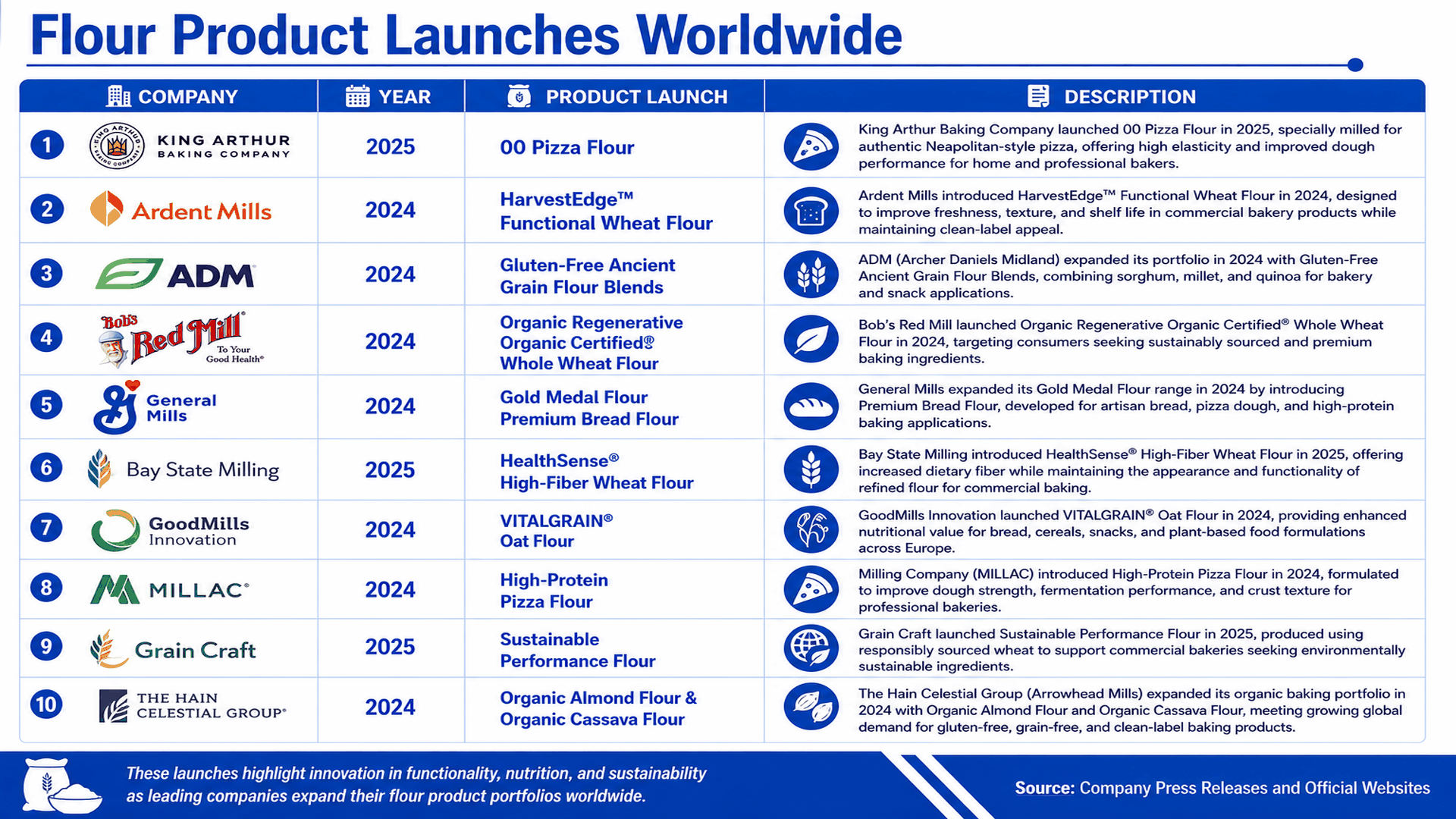
Flour Product Launches Worldwide
- King Arthur Baking Company launched 00 Pizza Flour in 2025, specially milled for authentic Neapolitan-style pizza, offering high elasticity and improved dough performance for home and professional bakers.
- Ardent Mills introduced HarvestEdge™ Functional Wheat Flour in 2024, designed to improve freshness, texture, and shelf life in commercial bakery products while maintaining clean-label appeal.
- ADM (Archer Daniels Midland) expanded its portfolio in 2024 with Gluten-Free Ancient Grain Flour Blends, combining sorghum, millet, and quinoa for bakery and snack applications.
- Bob’s Red Mill launched Organic Regenerative Organic Certified® Whole Wheat Flour in 2024, targeting consumers seeking sustainably sourced and premium baking ingredients.
- General Mills expanded its Gold Medal Flour range in 2024 by introducing Premium Bread Flour, developed for artisan bread, pizza dough, and high-protein baking applications.
- Bay State Milling introduced HealthSense® High-Fiber Wheat Flour in 2025, offering increased dietary fiber while maintaining the appearance and functionality of refined flour for commercial baking.
- GoodMills Innovation launched VITALGRAIN® Oat Flour in 2024, providing enhanced nutritional value for bread, cereals, snacks, and plant-based food formulations across Europe.
- Milling Company (MILLAC) introduced High-Protein Pizza Flour in 2024, formulated to improve dough strength, fermentation performance, and crust texture for professional bakeries.
- Grain Craft launched Sustainable Performance Flour in 2025, produced using responsibly sourced wheat to support commercial bakeries seeking environmentally sustainable ingredients.
- The Hain Celestial Group (Arrowhead Mills) expanded its organic baking portfolio in 2024 with Organic Almond Flour and Organic Cassava Flour, meeting growing global demand for gluten-free, grain-free, and clean-label baking products.
Challenges of the Flour Market
Volatility in Grain Prices and Climate-Related Supply Risks
One of the biggest challenges facing the flour market is the volatility of grain prices caused by changing weather patterns, geopolitical tensions, and supply chain disruptions. Wheat, maize, rice, and other grains are highly sensitive to droughts, floods, heatwaves, and other climate-related events that reduce agricultural yields. Industry estimates indicate that raw grain costs account for approximately 70–80% of flour production expenses, making flour manufacturers highly vulnerable to fluctuations in agricultural commodity prices. Export restrictions, transportation disruptions, and rising fertilizer and fuel costs can further increase production expenses and reduce profit margins. Milling companies often face difficulties maintaining stable pricing while remaining competitive in domestic and international markets. Unpredictable raw material availability also affects long-term procurement planning and inventory management. Investments in climate-resilient agriculture, improved grain storage facilities, diversified sourcing strategies, and precision farming technologies are becoming increasingly important to minimize supply risks and ensure stable flour production.
Rising Competition from Alternative Ingredients and Health Trends
The flour market is increasingly challenged by changing dietary preferences and the growing popularity of alternative food ingredients. Consumers are adopting low-carbohydrate, ketogenic, paleo, and high-protein diets, which often reduce consumption of traditional wheat-based products. At the same time, demand for grain-free and plant-based alternatives such as almond, coconut, cassava, and chickpea flour continues to expand. Industry estimates suggest that specialty and alternative flours are growing faster than conventional refined wheat flour in many developed markets, intensifying competition within the industry. In addition, increasing consumer awareness regarding gluten intolerance and celiac disease has accelerated demand for certified gluten-free products. Flour manufacturers must invest in research, product diversification, and dedicated processing facilities to prevent cross-contamination while maintaining quality standards. Meeting evolving consumer expectations for organic, clean-label, fortified, and minimally processed flour products increases production complexity and operational costs, presenting an ongoing challenge for traditional flour producers worldwide.
Wheat Flour Dominating Global Flour Consumption Through Staple Food Demand
The Wheat Flour Market represents the largest segment of the global flour industry, accounting for an estimated 70–75% of total flour consumption worldwide. Wheat flour remains the primary ingredient in bread, cakes, pastries, biscuits, pizza, pasta, noodles, and numerous processed food products. Rising urbanization, population growth, and increasing consumption of bakery and convenience foods continue driving demand across developed and emerging economies. Commercial bakeries, foodservice operators, and packaged food manufacturers are the largest consumers of wheat flour due to its excellent baking performance and gluten-forming properties. Manufacturers are increasingly introducing whole wheat, fortified, organic, and high-protein wheat flour products to meet evolving consumer preferences. Government flour fortification programs with iron, folic acid, and essential vitamins are further supporting market growth in several countries. Technological advancements in milling efficiency, grain quality improvement, and automated processing systems continue enhancing production capacity. Growing demand for premium bakery products and expanding retail distribution are expected to sustain long-term growth in the global wheat flour market.
Rice Flour Expanding Demand for Gluten-Free and Specialty Food Applications
The Rice Flour Market is witnessing significant growth due to increasing demand for gluten-free foods and specialty food ingredients. Industry estimates indicate that rice flour accounts for approximately 8–10% of the global specialty flour market, supported by rising consumer awareness of digestive health and gluten intolerance. Rice flour is widely used in bakery products, noodles, infant nutrition, snacks, confectionery, breakfast cereals, and traditional Asian foods. It is particularly popular among consumers seeking gluten-free alternatives to wheat flour because of its smooth texture and neutral flavor. Manufacturers are increasingly introducing fortified rice flour enriched with vitamins and minerals to improve nutritional value. The expanding use of rice flour in clean-label, organic, and plant-based food products is creating additional market opportunities. Food manufacturers also utilize rice flour as a thickening and binding agent in processed foods. Continuous innovation in specialty flour formulations and increasing adoption of gluten-free diets are expected to support sustained growth in the global rice flour market.
Bread and Bakery Products Largest Application Segment Supporting Flour Demand
Flour Bread and Bakery Products Market remains the dominant application segment for flour worldwide, accounting for an estimated more than 60% of total flour utilization. Bread continues to be one of the most widely consumed staple foods globally, while cakes, cookies, pastries, muffins, pizza bases, croissants, and artisan bakery products contribute significantly to flour demand. Rising disposable incomes, busy lifestyles, and increasing consumption of ready-to-eat bakery products continue driving market expansion. Commercial bakeries are investing in automation, premium ingredients, and product innovation to meet evolving consumer preferences for healthier and premium-quality baked goods. Whole grain, multigrain, gluten-free, and fortified bakery products are becoming increasingly popular among health-conscious consumers. Expanding supermarket bakery sections, café chains, quick-service restaurants, and online bakery delivery platforms further strengthen demand. Improvements in flour quality, milling technologies, and functional baking ingredients continue supporting innovation and sustained growth within the global bread and bakery products market.
Wafers Flour Rising Demand from Confectionery and Snack Manufacturing
Wafers Flour Market is experiencing steady growth due to expanding global demand for confectionery products, biscuits, wafer snacks, and chocolate-coated desserts. Wafer production primarily utilizes refined wheat flour because of its consistent particle size, low protein content, and ability to produce thin, crisp textures. Industry estimates indicate that wafer and biscuit products account for approximately 15–20% of industrial flour usage within the global confectionery and bakery sector. Increasing consumer preference for premium wafer products, filled wafers, protein-enriched snacks, and low-sugar confectionery continues creating opportunities for specialized flour manufacturers. Food companies are introducing innovative flavors, healthier formulations, and whole-grain wafer products to meet changing dietary preferences. Automated baking technologies, improved flour consistency, and precision milling processes contribute to higher production efficiency and product quality. Expanding demand from supermarkets, convenience stores, cafés, and e-commerce platforms continues supporting global wafer production and increasing consumption of specialized flour used in wafer manufacturing.
Flour Supermarkets Retail Driving Consumer Accessibility
Flour Supermarkets Market continues to expand as supermarkets and hypermarkets remain the largest retail distribution channels for packaged flour products. Industry estimates suggest that organized retail accounts for approximately 45–50% of packaged flour sales in many developed and rapidly urbanizing markets. Consumers increasingly purchase wheat flour, rice flour, multigrain flour, specialty flour, gluten-free flour, and fortified flour from supermarkets because of wider product availability, competitive pricing, and convenient shopping experiences. Major retailers also offer private-label flour brands alongside premium national brands, increasing consumer choice and market competition. Attractive product displays, promotional discounts, value packs, and growing demand for organic and health-focused flour products further encourage purchases. Supermarkets also provide better product traceability, quality assurance, and nutritional labeling, supporting informed consumer decisions. The continued expansion of organized retail infrastructure, modern grocery chains, and integrated omnichannel shopping is expected to strengthen supermarket sales and drive long-term growth in the global flour market.
United States Strong Demand from Bakery, Food Processing, and Convenience Foods
United States Flour Market is one of the largest globally, supported by a highly developed grain processing industry and strong consumption of bakery and packaged food products. The country produces more than 45 million metric tons of wheat annually, ensuring a reliable supply of raw materials for flour milling. Wheat flour accounts for over 80% of flour consumption in the U.S., driven by demand from bread, pizza, cakes, cookies, pasta, and breakfast cereals. Commercial bakeries, quick-service restaurants, and packaged food manufacturers are major end users, while supermarkets and warehouse retailers dominate flour distribution. Increasing consumer preference for whole wheat, gluten-free, organic, and fortified flour products has encouraged manufacturers to diversify their portfolios. Automation, digital milling technologies, and improved grain storage systems continue enhancing production efficiency. Growing home baking trends, premium bakery consumption, and expanding exports of processed food products are expected to support steady long-term growth in the United States flour market.
Premium Bakery Products Driving United Kingdom Market Expansion
United Kingdom Flour Market continues to grow steadily due to sustained demand for bakery products and increasing consumer preference for healthier flour varieties. Industry estimates indicate that bread and bakery products account for more than 65% of flour utilization across the country. Wheat flour remains the dominant segment, while rye, oat, wholemeal, and gluten-free flours are gaining popularity among health-conscious consumers. The UK has a mature bakery industry supplying supermarkets, cafés, artisan bakeries, hotels, and foodservice operators. Manufacturers are increasingly introducing fortified flour containing calcium, iron, and vitamins in line with national nutritional standards. Rising demand for organic, stone-ground, and clean-label flour products is creating new premium market opportunities. Technological improvements in milling operations and sustainable packaging are also enhancing competitiveness. Growing online grocery sales, expansion of premium bakery chains, and consumer interest in homemade baking continue supporting the long-term development of the United Kingdom flour market.
India Expanding Food Processing and Rising Wheat Production Supporting Growth
India Flour Market is witnessing strong growth due to increasing population, rapid urbanization, and expanding food processing industries. India is the second-largest wheat producer globally, producing over 110 million metric tons of wheat annually, providing abundant raw material for flour manufacturing. Wheat flour (atta) remains the most widely consumed flour, while rice flour, maize flour, millet flour, and multigrain flour are gaining popularity due to changing dietary preferences. Traditional foods such as chapati, roti, naan, and paratha continue to drive household flour consumption, while growing demand for bread, biscuits, noodles, pasta, and packaged foods supports industrial flour usage. Organized retail, e-commerce, and modern flour milling facilities are expanding product availability nationwide. Government initiatives promoting food fortification have encouraged the production of flour enriched with iron, folic acid, and vitamin B12. Rising health awareness, increasing disposable incomes, and growing demand for premium and specialty flours are expected to sustain robust growth in the Indian flour market.
Saudi Arabia Food Security Initiatives and Growing Bakery Industry Fueling Demand
Saudi Arabia Flour Market is expanding steadily due to rising food consumption, increasing urbanization, and government initiatives supporting food security. Wheat flour remains the dominant product, accounting for more than 70% of total flour consumption, as it is widely used in bread, flatbreads, pastries, cakes, biscuits, and traditional baked products. Strong demand from commercial bakeries, restaurants, hotels, and food manufacturers continues driving market expansion. The country’s modern retail sector, including supermarkets, hypermarkets, and convenience stores, has improved the availability of packaged flour products and specialty flour varieties. Consumers are increasingly purchasing whole wheat, multigrain, and fortified flour in response to growing health awareness. Government investments in food manufacturing, grain storage, and flour milling infrastructure have strengthened domestic production and supply chain efficiency. Additionally, rising demand for premium bakery products, expanding hospitality activities, and increasing consumption of convenience foods are expected to support sustained long-term growth in the Saudi Arabian flour market.
Market Segmentation
Raw Material
- Wheat
- Maize
- Rice
- Others
Application
- Pasta
- Bread and Bakery Products
- Wafers, Crackers and Biscuits
- Animal Feed
- Non-Food Application
- Others
Sales Channel
- Supermarkets
- Hypermarkets
- Online Stores
- Others
Regional Insights
North America
- United States
- Canada
Europe
- France
- Germany
- Italy
- Spain
- United Kingdom
- Belgium
- Netherlands
- Turkey
Asia Pacific
- China
- Japan
- India
- South Korea
- Thailand
- Malaysia
- Indonesia
- Australia
- New Zealand
Latin America
- Brazil
- Mexico
- Argentina
Middle East & Africa
- Saudi Arabia
- United Arab Emirates
- South Africa
All the Key players have been covered
- Overviews
- Key Person
- Recent Developments
- SWOT Analysis
- Revenue Analysis
Competitive Landscape
- King Arthur Flour Company
- Associated British Foods Plc.
- Hindustan Unilever Ltd
- Archer Daniels Midland Company
- Conagra Foods Inc.
- Cargill, Incorporated
- ITC Ltd
- General Mills, Inc.
Report Details:
| Report Features | Details |
| Base Year |
2025 |
| Historical Period |
2022 - 2025 |
| Forecast Period |
2026 - 2034 |
| Market |
US$ Billion |
| Segment Covered |
Raw Material, Application, Sales Channel and Countries |
| Countries Covered |
|
| Companies Covered |
|
| Customization Scope |
20% Free Customization |
| Post-Sale Analyst Support |
1 Year (52 Weeks) |
| Delivery Format |
PDF and Excel through Email (We can also provide the editable version of the report in PPT/Word format on request) |
Customization Services available
- Analysis of Market Size and Its Segments
- More Company Profiles (Upto 10 without any additional cost):
- Additional Countries (Other than mentioned Countries):
- Region/Country Specific Reports:
- Market Entry Strategy:
- Region-Specific Market Dynamics:
- Regional Market Share Analysis:
- Trade Analysis:
- Production Insights:
- Others Customized Requests:
For more information contact our analysts.
Need More Assistance?
- Talk to our analysts to get more precious information on the current market trends.
- Include more countries and segments and customize the report based on the final requirement.
- Get a competitive advantage in your industry by knowing the report findings and making a positive impact on your revenues and operations.
- Our analysts are always ready to provide more help and pertinent information if you need any additional assistance.